The Wreck Files
A searchable archive of U.S. Coast Guard vessel casualty and wreck reports, 1913–1938, transcribed by AI and published beside the original scans so anyone can check the reading for themselves.
What it does
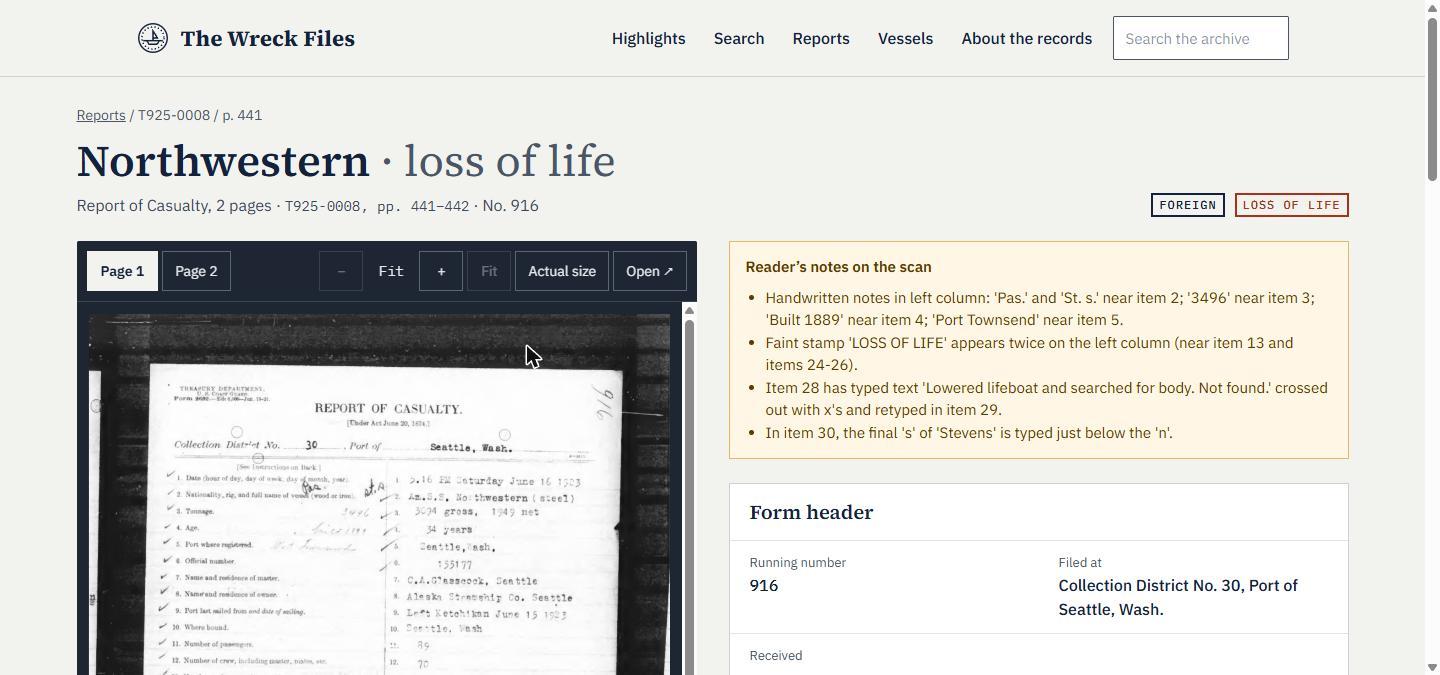
The National Archives holds these reports as grainy, tilted microfilm: forms filled in by masters, owners and agents after a collision, stranding, fire or total loss. The Wreck Files turns them into structured, searchable records. Search by vessel name or describe what happened — “a sailor fell overboard” — and every result opens to the transcription next to the scan it came from, with a reader’s notes on stamps, pencil marks, and anything illegible.
How it runs
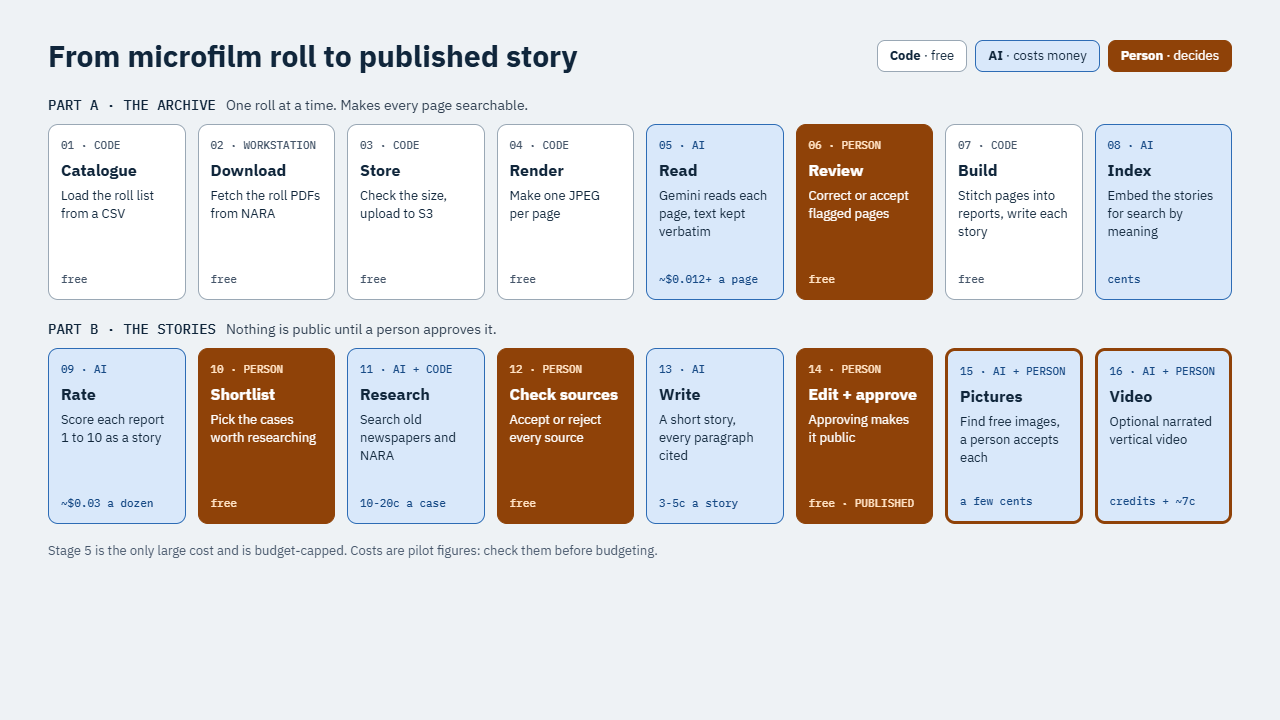
From a scanned microfilm roll to a published, researched, illustrated story. Part A makes every page searchable and is where nearly all the money goes. Part B finds the stories worth telling, and nothing in it is public until a person approves it.
- codePlain code. Free, repeatable, gives the same answer twice.
- AIA model call. Costs money, is logged, and its output is a proposal.
- personA member of staff decides. The next stage won’t run on what they haven’t decided.
Part A · From a roll of microfilm to searchable reports
Each microfilm roll is listed from the National Archives catalogue — its title, page count, and where the PDF lives — so we always know what exists and what has been done.
The roll PDFs come from the National Archives’ own media server to a local disk. It’s a deliberate workstation step, not a button anyone can press by accident.
Each PDF is checked against the catalogue before it’s kept. A truncated download fails here, not three steps later, and only then is it uploaded to cloud storage.
Every roll is split into one image per page. Reading refuses to start on a roll that hasn’t been rendered.
One page per call, a vision model transcribes the thirty numbered items, the stamps, and the signature against a fixed schema. Text is kept verbatim, a blank beats a guess, and our own code checks the model. This is the one step with a real cost, so it runs under a budget cap.
Reports where a check tripped wait in a review queue, one beside its scan. A person corrects a value or accepts the flag as it is. The model’s reading is never overwritten — corrections are laid on top, and each one records who made it.
Pages are stitched into reports, filings of the same casualty are linked, and each report gets a readable summary from a template, not from a model. A flagged report isn’t searchable until it has been reviewed.
Each report’s summary is embedded and stored in a vector index, so visitors can search by meaning — “a sailor fell overboard” — as well as by vessel name. It costs cents, and only changed reports are re-sent.
Part B · From a report to a published story
A model reads a dozen reports at a time and scores each one 1–10 as a story, with a category, a one-line hook, and whether the vessel’s name is distinctive enough to look for elsewhere.
A person reads the scores and hooks, shortlists the cases worth researching, and passes on the rest. Nothing is spent researching a case nobody chose.
For each shortlisted case: search old newspapers on Chronicling America from the day before to 45 days after the casualty, and National Archives catalogue titles. A page is read only if the vessel’s name appears beside talk of ships, and any article a model extracts is checked in code against its page — an invented sentence or number drops it.
A person opens every source and accepts or rejects it. This is the identity check that catches a wrong-vessel match a model let through. A story can only use accepted sources.
A model drafts 100–220 words from the government record and the full text of the accepted articles. Every paragraph lists the sources it used, and a paragraph that cites nothing real is dropped.
A person edits the headline and paragraphs, or sends it back for a fresh draft. Approving publishes it with a disclosure that AI helped and staff checked it, and it can be unpublished at once.
A finder looks in Wikimedia Commons, the Library of Congress, and the National Archives for freely usable images of the vessel, nothing dated after 1930. A person accepts or rejects each one. Pictures are links with credit and rights, not copies, and only accepted ones on a published story are public.
Optional experiment: a vertical narrated video of a published story — script, voice, end card, render — with a person editing at each step. Nothing is public, there’s no music, and every video says the voice is AI.
Highlighted cases
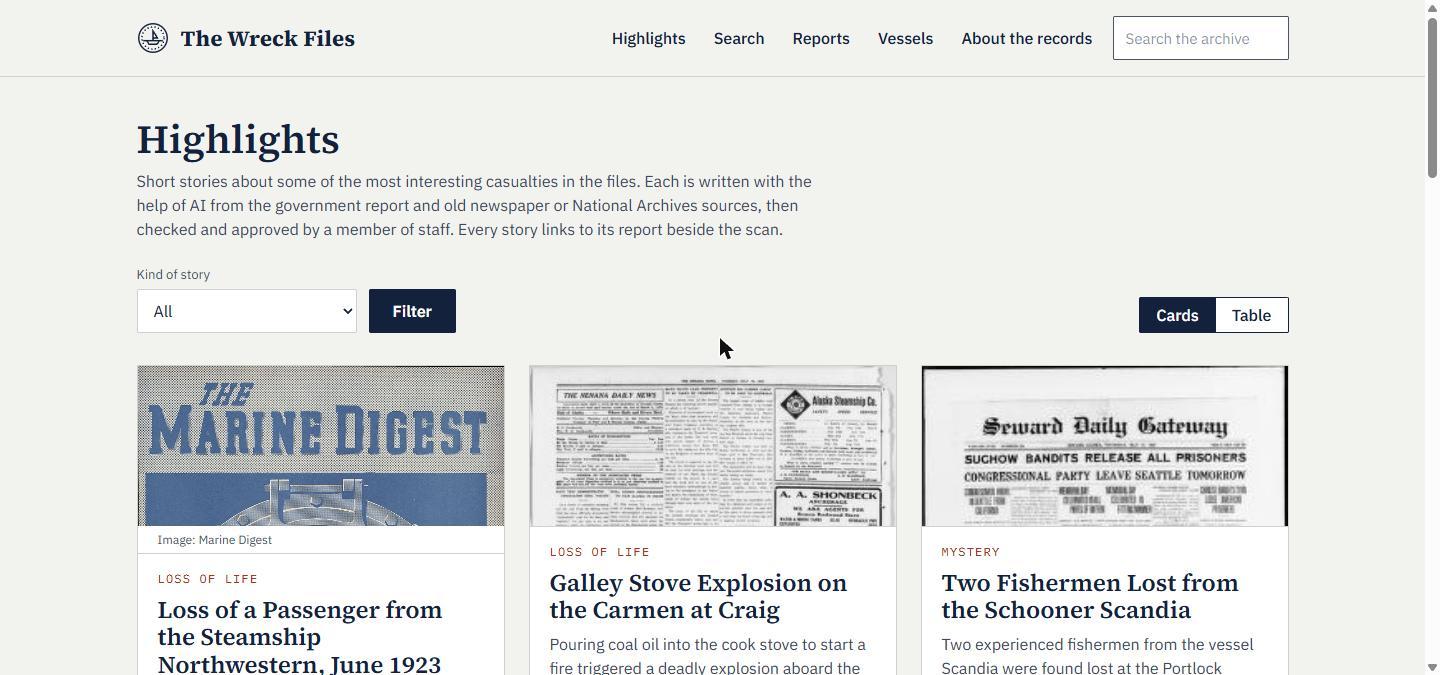
Among hundreds of dry forms, a few have a story in them. The highlights pipeline finds them, researches what else is known, and drafts a short account — each one disclosed as written with AI and checked by staff, and each linked back to its report and scan.
A transcription is not ground truth, and the site says so. Every field can be checked against its scan, and the archive grows as more microfilm rolls are processed.
The process at a glance
Click to open full size. Costs are pilot figures.